
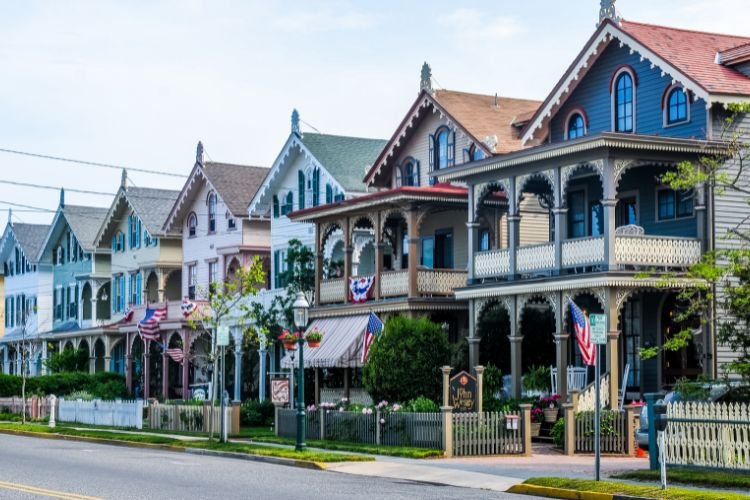
The city remembers buildings no longer there
The Lost Grand Hotels of Cape May
A resort teaches visitors to look at what stands. History also asks them to imagine what has vanished. Cape May once rose around enormous hotels whose dining rooms, verandas, servants, and seasonal crowds created a temporary city by the sea. Some burned. Some failed. Some yielded to new ideas of comfort. Their absence still shapes the streets.
A resort teaches visitors to look at what stands. History also asks them to imagine what has vanished. Cape May once rose around enormous hotels whose dining rooms, verandas, servants, and seasonal crowds created a temporary city by the sea. Some burned. Some failed. Some yielded to new ideas of comfort. Their absence still shapes the streets.
01
The hotel as a summer world
Nineteenth-century travel demanded an institution larger than a room. A grand hotel received guests, fed them, entertained them, introduced them, and made the shore respectable. Its porch served as theater and social register.
Cape May’s large hotels competed through scale, location, service, and reputation. They also depended on transport networks, seasonal labor, reliable provisions, and the fragile confidence that visitors would return.
02
Wooden grandeur
Timber allowed hotels to rise quickly and accept elaborate ornament. It also made them vulnerable. Kitchens, lamps, heating equipment, stables, and closely spaced buildings increased risk. Cape May’s fires were not isolated accidents in an otherwise permanent city. They were recurring forces in its development.
When a hotel disappeared, more than rooms were lost. Employment, supplier relationships, social rituals, and the orientation of nearby streets could change with it.
03
Names that outlived walls
The United States Hotel, Columbia House, Ocean House, Stockton Hotel, and other establishments moved through Cape May’s history in different forms. Some names were reused after rebuilding. Some buildings expanded, contracted, or returned under new ownership.
This makes the phrase “lost hotel” complicated. A hotel can survive as a name, a site, a memory, or a partial structure. Historical maps and advertisements often reveal continuities that a modern walk cannot.
04
Why the age of giants passed
Travel fashion changed. Rail connections reshaped access, and competing resorts offered newer buildings and different amusements. Maintaining vast seasonal properties was expensive. The twentieth century favored automobiles, smaller lodging, private baths, and eventually motels.
The decline of one hotel model did not end Cape May. It changed the scale of hospitality. Inns, guesthouses, apartment hotels, and modern resorts filled parts of the old role.
05
The survivors
Congress Hall, the Chalfonte, and other historic properties allow visitors to experience fragments of the grand-hotel world, though every survivor has changed. Fire codes, plumbing, accessibility, and contemporary expectations necessarily alter old buildings.
Preservation is not the freezing of a perfect year. It is an agreement to keep adapting without erasing the character and evidence that make a place distinct.
06
Walking with ghosts of scale
Look at an open lot, a broad lawn, or an unexpectedly generous setback. Ask what once organized the block. Then compare old maps with the present street. The exercise changes absence into a visible historical fact.
Cape May’s lost hotels matter because they remind us that tourism is an economy before it becomes nostalgia. Buildings endure only when communities find a way to carry them into another use and another generation.
A slower way to carry the story
Leave one hour unclaimed. Walk a route connected with the subject and notice changes in light, sound, material, and pace. Write one clear sentence about what is present. Description disciplines the eye because it resists the easy substitution of mood for fact.
Return to one location at a different hour. Morning and evening do not simply alter a photograph. They change who uses a street, which details become visible, and how the coast sounds. Compare expectation with observation. Let the difference remain in the notes.
When conversation arises naturally, ask a person who works in town one plain question. Listen without asking them to perform local knowledge. Courtesy is a better guide than curiosity without limits, especially in a community that receives visitors every day.
Read one primary source after the walk. Separate documented history, local legend, personal memory, and present-day operations. All can enrich a visit, but they should not be confused. Precision does not diminish wonder. It gives wonder a sound foundation.
End somewhere you can sit. Review the day without forcing it into a verdict. A place becomes richer when it resists summary. The goal is not to master Cape May in an afternoon. It is to leave with a better question than the one you brought.
A reader’s field exercise
Carry four questions into the streets
The hotel as a summer world
Find one visible detail connected with this idea. Describe it before photographing it. Ask what the place reveals and what the first glance leaves unexplained. Then locate the primary source that can test your first impression. Record its date, name the institution responsible for it, and notice where documented fact ends. A careful visitor can enjoy atmosphere without asking atmosphere to serve as proof.
Wooden grandeur
Find one visible detail connected with this idea. Describe it before photographing it. Ask what the place reveals and what the first glance leaves unexplained. Then locate the primary source that can test your first impression. Record its date, name the institution responsible for it, and notice where documented fact ends. A careful visitor can enjoy atmosphere without asking atmosphere to serve as proof.
Names that outlived walls
Find one visible detail connected with this idea. Describe it before photographing it. Ask what the place reveals and what the first glance leaves unexplained. Then locate the primary source that can test your first impression. Record its date, name the institution responsible for it, and notice where documented fact ends. A careful visitor can enjoy atmosphere without asking atmosphere to serve as proof.
Why the age of giants passed
Find one visible detail connected with this idea. Describe it before photographing it. Ask what the place reveals and what the first glance leaves unexplained. Then locate the primary source that can test your first impression. Record its date, name the institution responsible for it, and notice where documented fact ends. A careful visitor can enjoy atmosphere without asking atmosphere to serve as proof.
Stay on public routes. Respect homes, wildlife, posted closures, and the work of local businesses. A more attentive visitor usually becomes a lighter presence.
Plan with confidence
Current information outranks an old list
Hours, prices, menus, transportation, and access can change. Use this story to understand the choice. Use the official source to confirm the final detail for your date.
Reader questions
historic Cape May hotels FAQs
Direct answers with links to the institutions that hold the current record.
What were Cape May’s grand hotels?
They were large seasonal resorts that combined lodging, dining, entertainment, and social life.
Why did so many disappear?
Fire, changing travel patterns, economics, maintenance costs, and redevelopment all played roles.
Are any grand historic hotels still open?
Several historic properties survive in adapted form, including Congress Hall and the Chalfonte.
Did the 1878 fire destroy hotels?
Yes. The blaze destroyed a large portion of the central resort district.
Where can I research old hotel sites?
Historic maps, City preservation documents, museum archives, and Cape May MAC programs are useful starting points.
The journal continues
Read Cape May with a slower eye
Explore original stories and practical guides to the architecture, coast, food, wildlife, and people that give the town its character.