
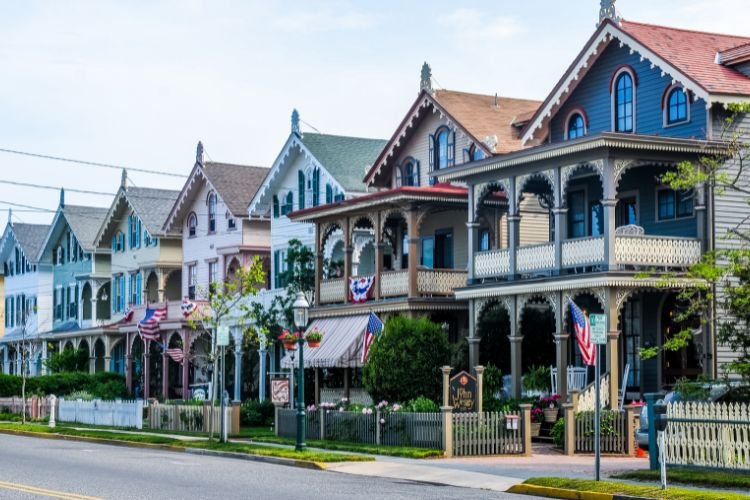
The Cape May Historic District: A Free Self-Guided Walking Route
Around 600 Victorian buildings sit inside a National Historic Landmark district you can cross in twenty minutes. You can pay someone to drive you past them, or follow the route below, which costs nothing and lets you stop.
Start the walkWhat the Historic District actually is
The Cape May Historic District was designated a National Historic Landmark in 1976, the highest historic designation the United States gives. It isn’t a museum or a ticketed site. It’s a working town where people live, run inns, argue about parking and repaint their porches.
It covers most of old Cape May City — roughly the blocks between Beach Avenue and Lafayette Street, from the Congress Hall end to the Emlen Physick Estate. Around 600 Victorian-era buildings, which is the right order of magnitude but an estimate, not a census. If you want the rest of the town rather than the architecture, start with everything else worth doing in town.
At a glance
- Designated
- National Historic Landmark, 1976
- Roughly
- 600 Victorian-era buildings
- Cost to walk it
- Nothing. These are public streets
- Time needed
- About two hours for the route below; one hour for the short version
- Best hours
- 7–9am for empty streets and low light; 5–7pm for porch life
- Start point
- Cape May Welcome Center, 609 Lafayette Street — free parking, restrooms
Prices and hours verified August 2026. Call ahead — Cape May businesses change seasonally.
Why everything looks like it was built in the same decade
Because a great deal of it was.
Cape May was already one of the country’s oldest resorts when a fire in 1878 destroyed a large part of the town centre. What replaced it went up fast, in the same handful of years, using the same catalogue millwork and the same fashionable styles. Most American towns accumulate architecture over a century and a half — a Federal house next to a 1920s bungalow next to 1970s infill. Cape May got rebuilt in one push, then stopped growing as the railroads and later the highways sent the crowds to Atlantic City and the Wildwoods. Poverty preserved it. The town was too quiet for most of the twentieth century for anyone to profitably knock the houses down, and by the time it was busy again the 1976 designation had arrived. What’s left is a tight sample of American domestic architecture from roughly the 1860s to the 1890s. Learn five styles and the whole town becomes legible.
Five styles you'll be able to name by the end of the walk
You don’t need an architecture degree. You need one tell per style.
Gothic Revival
Look up at the gable. A steep point with carved trim down its edges — the sawn woodwork people call gingerbread, properly bargeboard. Windows often pointed or arched.
Italianate
Look where the wall meets the roof. Scroll-shaped brackets under a deep overhanging eave. Roofs low-pitched, nearly flat from the street. Windows tall, narrow, often paired and hooded. The calmest of the five.
Second Empire
Look at the roof shape. A mansard — two slopes a side, the lower one steep and almost vertical, dormers punched through. It buys a full extra floor inside the roof, which is why hotels liked it. If a house looks like it’s wearing a hat, this is it.
Stick Style
Look at the wall surface. Flat boards applied in horizontal, vertical and diagonal patterns, as though the frame has been drawn on the skin. The most distinctly American of the five, and Cape May has it in quantity. Spot the diagonal braces in one gable end and you’ll see them everywhere.
Queen Anne
Look for asymmetry and texture. The show-off: a corner turret, a wraparound porch, bay windows, two or three wall surfaces on one elevation. If no two sides match, it’s Queen Anne. Generally the latest of the five.
The free self-guided walk: eleven stops, about two hours
A loop. Starts and ends at free parking, and costs nothing unless you go inside something. Walk it in this order and the architecture builds — you finish at the two biggest buildings in town rather than starting with them.
Park here. Free parking, restrooms, a Cape May MAC ticket outlet, and six ChargePoint EV stations — the best place in town to leave a car charging while you walk. It’s also home to the free “Revolutionary Cape May” exhibit, ten minutes that set up two centuries of context before you look at a single porch.
A short walk on. The building is the historic Howell House, former parsonage of Macedonia Baptist Church. Admission $15 adults, $10 children 10 and under plus fees, entry timed by the hour — book ahead, closed all January. Even if you don’t go in today, stand in front of it for a minute. It’s the hinge of the second history this town has, and most visitors walk straight past.
Three blocks of Washington Street with the cars removed. You’re here for the streetscape and the Information Booth at Washington and Ocean Streets, not the shopping — the shops have their own guide. Look up above the shopfronts. Ground floors have been modernised for retail; second and third floors frequently haven’t, and that’s where the brackets, mansards and window hoods survive. The best “look up” block in town.
Past the mall the street turns residential within a block. You’ll pass City Hall at 643 Washington Street, the Southern Mansion at 720 and the Inn at the Park at 1002. Watch the setbacks grow as the numbers rise — big lawns, deep porches, carriage houses at the back.
The end of the street and the climax of the walk. An 18-room house from 1879 by Frank Furness, on grounds you can walk without paying. Inside is a ticketed MAC house tour — $20 adults, $15 children 3–12. More on Furness below.
Turn back toward the sea and pick up Columbia Avenue, where the postcard version of Cape May actually lives — porch after porch, most of the houses now inns. Walk down through the numbers: the Dormer House at 800, the Bacchus Inn at 710 and Casablanca at 709 facing each other, the Mainstay Inn at 635, the Mason Cottage at 623–625, the Harrison at 613. Do this block slowly. Highest concentration on the route, and the place to run the five-style spotting game.
The Mooring at 801 Stockton Avenue and the Bedford Inn at 805 sit almost side by side, and round on Trenton Avenue is the Angel of the Sea at 5 — reputedly cut in half and moved, and one of the most photographed buildings in New Jersey.
Gurney Street is short, runs toward the beach, and is where the matched-cottage effect is strongest — houses built as a set rather than individually, which is why they rhyme. Then Ocean Street, one of three streets MAC’s own architectural walking tour uses. The Queen Victoria® at 102, Beauclaire’s at 23 and the Inn of Cape May at 7 take you down toward Beach Avenue as the numbers fall.
If you only walk one street in Cape May, walk Hughes Street. One block over from Washington, residential the whole way, no shops, very little traffic. The 500 block is the one to do — the closest thing to what the whole town looked like before the parking meters, and the quietest place in the district at eight in the morning.
Jackson Street is the oldest street in Cape May and it feels different from everything you’ve just walked — narrower, denser, older housing stock, ending at the ocean. The Virginia Hotel at 25 and the Carroll Villa Hotel at 19 are here, with the Virginia Cottages on the historic stretch. Stand at the beach end and look back up it: that’s the view Cape May had before it had a promenade.
Finish at the biggest building in town. Congress Hall, 200 Congress Place — enormous, yellow, colonnaded, open to anyone who wants to walk the lobby. The Victorian at 223 Congress Place faces it. One block over is The Chalfonte Hotel at 301 Howard Street, older and plainer and wooden, with wraparound verandas. From here you’re a few blocks from the car, and you’ve covered the district.
Cape May Welcome Center, 609 Lafayette Street
Harriet Tubman Museum, 632 Lafayette Street
The Washington Street Mall, 300–500 Washington Street
Washington Street, 600 to 1000
Emlen Physick Estate, 1048 Washington Street
Columbia Avenue, 800 down to 600
Stockton Avenue and Trenton Avenue
Gurney Street and Ocean Street
Hughes Street
Jackson Street, the oldest street in town
Congress Place, Congress Hall and Howard Street
The Painted Ladies, and why those colours are a modern decision
“Painted Ladies” means a Victorian house painted in three or more contrasting colours to pick out the architectural detail — the brackets one colour, the trim another, the body a third, the porch spindles a fourth.
Here’s the part visitors don’t expect: the term is twentieth-century, and most of the schemes you’re admiring are modern. The movement to repaint Victorians in elaborate multi-colour took off in the 1960s and 70s, and Cape May adopted it at exactly the moment it was rediscovering itself as a historic town.
The houses are genuinely Victorian. The colour schemes are mostly a love letter written a hundred years later.
That doesn’t make them fake. Bright contrasting exterior paint was authentically Victorian — the era liked colour far more than the white-clapboard image suggests. But these specific palettes are choices made in living memory, and knowing that makes the walk more interesting, not less.
Best Painted Lady blocks on the route: Columbia Avenue between 600 and 800, and Gurney Street.
Living history you can walk into
Two of the district’s most significant buildings are hotels, so you can walk in without a ticket and look around. Buy a coffee if you’re going to linger — that’s the deal, and it’s a good one.
Congress Hall, 200 Congress Place
The scale is the thing. Walk the colonnade, then stand on the lawn and take in the yellow front. It tells you Cape May was a national resort long before it was a preservation project.
The Chalfonte Hotel, 301 Howard Street
Smaller, older-feeling, wooden, verandas wrapping the outside. Congress Hall shows you the grandeur; the Chalfonte shows you the boarding-house side of Victorian seaside holidaying, which is how most people actually did it. Both are in our hotels guide if you want to stay rather than look.
Frank Furness and the Emlen Physick Estate
1048 Washington Street. Eighteen rooms, built in 1879 for Dr. Emlen Physick and attributed to Frank Furness, the Philadelphia architect whose work looks like nothing else in nineteenth-century America.
Compare it to everything else you’ve walked past. The Columbia Avenue houses are pretty. This one isn’t trying to be. The chimneys are absurdly oversized and flare outward at the top. The brackets under the eaves are inverted, pushing down rather than holding up. Nothing is delicate.
Furness’s buildings were unfashionable for most of the twentieth century and many were demolished. That this one survived is most of why Cape May MAC exists at all — the 1970s campaign to save it is the origin story of the organisation that now runs the trolleys, the lighthouse and the house tours.
Inside: adults $20, children 3–12 $15, MAC members 25% off. The first floor is fully accessible, the first two floors are air conditioned, and parking is free and RV-friendly. The Carriage House holds the museum shop and the Carroll Gallery, showing “Cape May — First and Only,” May 1 to November 2, 2026.
The Black history of Cape May, in one walk
Cape May’s Victorian architecture is the history everybody arrives knowing about. A second history runs underneath it on some of the same streets, and it’s hard to find because nobody has assembled it in one place. Here it is, in the order you can walk it.
Harriet Tubman Museum, 632 Lafayette Street
Harriet Tubman worked in Cape May. She took seasonal work in this resort town’s hotels and households and used the wages to fund her rescue missions south. Cape May wasn’t somewhere she passed through — it was part of the financing.
The museum occupies the Howell House, historic parsonage of Macedonia Baptist Church.
- Admission: $15 adults, $10 children 10 and under, plus processing fees
- Entry is timed by the hour — book ahead. This catches people out constantly
- Summer (Juneteenth to September 17): Wed–Sat 11am–3pm, Sun 2–3pm
- Off-season (September 17 to Juneteenth): Fri–Sat 11am–3pm, Sun 2–3pm
- Closed the entire month of January
Those windows are narrow — Sunday is a single hour. Plan the day around it rather than hoping to drop in.
Macedonia Baptist Church and Union Bethel
Macedonia Baptist Church and Union Bethel are the two historic Black congregations at the centre of this story. The Macedonia parsonage is now the Tubman museum; the churches are active places of worship, not attractions.
Stephen Smith
Stephen Smith was a Black lumber merchant and abolitionist — one of the wealthiest Black men in nineteenth-century America — with a documented Cape May connection. His name is in every serious account of Black Cape May and almost none of the tourist-facing ones.
Mt. Zion Cemetery
Mt. Zion Cemetery is the historic Black burial ground associated with this community.
Center for Community Arts
The Center for Community Arts has done the local work of documenting and preserving this history. They partner with Cape May MAC on the Underground Railroad trolley tour — the way to get it narrated rather than researched. There’s also a Black Legacy in Historic Cape May trolley and a combination ticket pairing it with the Tubman museum. Prices in our tours guide.
Revolutionary Cape May: a free exhibit through December 31, 2026
When to walk it
7am to 9am is the best walk of the day, any month. No cars in front of the houses, no delivery vans, low raking light that throws every bracket and every piece of stickwork into relief. If you’re photographing, this is the only real answer.
5pm to 7pm in summer is second-best and more sociable. Avoid 11am to 3pm in July and August: flat overhead light, full parking, Washington Street shoulder to shoulder.
The off-season is underrated for this. The buildings don’t close. January to March you’ll have Hughes Street and Columbia Avenue to yourself, meters are off entirely, and bare trees reveal more of the architecture. Bring a coat — January averages a high around 43°F.
Two dates to plan around: Victorian Weekend, October 9–12, and the Christmas Candlelight House Tours, Saturdays December 6, 13 and 20, 5:30–8:30pm, which take you inside homes, inns, churches and hotels across a three-quarter-square-mile stretch of the district. For the full month-by-month picture, see our guide to the best time to visit.
Parking, restrooms and porch etiquette
Parking. Meters run 10am to 10pm at $1.50 an hour, and $2.00 an hour on the premium streets — which unhelpfully include most of the ones on this walk: Congress Place, Congress Street, Decatur, Jackson, Ocean, Perry, the 600 block of Washington and the 500 blocks of Hughes and Columbia. Meters are off entirely January 1 to March 31. The free alternative is the Cape May Elementary School lot at Lafayette and Madison, free until 11pm.
Restrooms. The Welcome Center at the start, and very little else. Plan accordingly.
Porch etiquette. People live in these houses.
Do
- Photograph from the public sidewalk, freely
- Walk the Physick Estate grounds, which are open
- Go into Congress Hall and the Chalfonte and look around
Don't
- Walk up a private path or onto a porch
- Photograph through a window
- Assume an inn’s front garden is public because it has a sign
- Block a driveway for “just a second” to take a picture
If you'd rather ride than walk
Cape May MAC runs a Historic District trolley tour, an hour-long Architectural Walking Tour covering Hughes, Ocean and Columbia, a Painted Ladies / Porches & More walk, a 90-minute electric cart tour called Backstreets & Byways, and a self-guided tour book with 90-plus stops.
More than twenty-five named tours run here and most operators don’t publish prices. We’ve put every one into a single comparison table on our Cape May tours guide.
Trolleys leave from the Ocean Street Trolley Stop, across from the Information Booth at Washington and Ocean Streets, and you’re asked to arrive 15 minutes early.
Frequently asked questions
Is the Cape May Historic District free to visit?
Yes. The district is a set of ordinary public streets and walking it costs nothing. There’s no gate, no ticket and no admission. You only pay if you choose to go inside something — the Emlen Physick Estate ($20 adults), the Harriet Tubman Museum ($15 adults) or a MAC trolley or walking tour. The self-guided route on this page is free.
How many Victorian houses are in Cape May?
Around 600 Victorian-era buildings sit inside the Historic District, which was designated a National Historic Landmark in 1976. Most of them date from a tight window between roughly the 1860s and the 1890s, because a fire in 1878 destroyed a large part of the town and the rebuild happened fast and all at once.
What is the best street to see Victorian houses in Cape May?
Columbia Avenue between the 600 and 800 blocks for the highest concentration of intact, elaborately painted houses, and Hughes Street — particularly the 500 block — for the quietest and most residential feel. Gurney Street has the best matched-cottage effect. Jackson Street is the oldest street in town and the one that feels least like the rest.
Can you go inside the Victorian houses in Cape May?
Some of them. The Emlen Physick Estate at 1048 Washington Street is a house museum with paid tours. Many of the others are working inns and B&Bs, so you can go in as a guest. Two hotels — Congress Hall at 200 Congress Place and The Chalfonte at 301 Howard Street — let anyone walk through the public rooms free. Everything else is a private home.
How long does it take to walk the Cape May Historic District?
About two hours at a browsing pace for the full eleven-stop route on this page, or one hour if you stick to Columbia Avenue, Hughes Street and Jackson Street. The district is compact enough to cross in twenty minutes if you’re just walking. Add time for the Physick Estate grounds and any building you go inside.
What is Cape May's connection to Harriet Tubman?
Harriet Tubman worked seasonally in Cape May’s hotels and households and used the wages to help fund her rescue missions. The Harriet Tubman Museum at 632 Lafayette Street tells that story from the historic Howell House, the former parsonage of Macedonia Baptist Church. Admission is $15 adults, $10 children 10 and under, entry is timed by the hour, and it’s closed every January.
Why was Cape May made a National Historic Landmark?
Because it holds one of the largest and most complete collections of nineteenth-century wooden seaside resort architecture in the United States, concentrated in a small area and largely unaltered. The designation came in 1976. The town’s long quiet period through the twentieth century is a major reason so much of it survived intact.
When is the best time of day to photograph Cape May's Victorian houses?
Between 7am and 9am. The streets are empty of parked cars, the light is low and raking, and the architectural detail — brackets, stickwork, bargeboard — reads properly instead of flattening out. Late afternoon from about 5pm is the second-best window and gives warmer colour. Avoid 11am to 3pm in July and August.
Prices and hours verified August 2026. Call ahead — Cape May businesses change seasonally.