
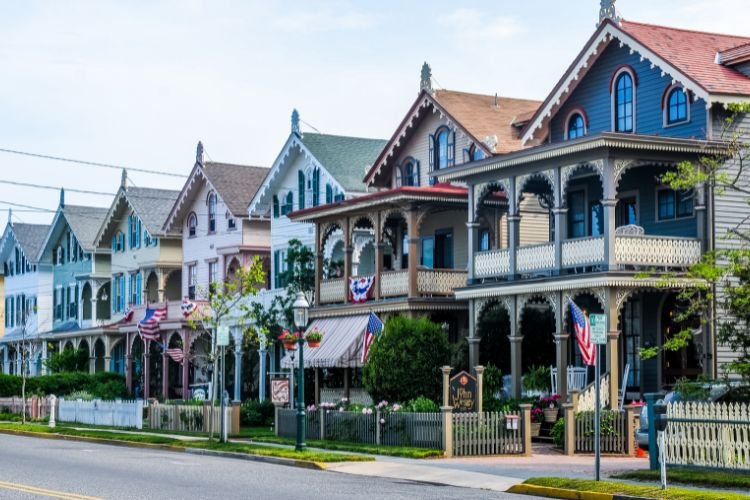
The houses are telling you how to look
How to Read a Cape May Victorian House
Cape May’s houses do not ask for an expert vocabulary. They ask for time. Stand across the street. Let the whole building settle into view. Then notice how the porch meets the sidewalk, how the roof changes shape, and where ornament gathers. Architecture becomes legible when we stop treating it as a backdrop.
Cape May’s houses do not ask for an expert vocabulary. They ask for time. Stand across the street. Let the whole building settle into view. Then notice how the porch meets the sidewalk, how the roof changes shape, and where ornament gathers. Architecture becomes legible when we stop treating it as a backdrop.
01
Begin with the silhouette
The roofline gives the first clue. A steep gable feels different from a broad mansard roof. A tower pulls the eye upward, while a long veranda keeps attention near the street. Cape May contains many Victorian-era modes rather than one uniform style. The pleasure lies in comparison.
Notice whether the house rises like a narrow ship or settles across its lot. Trace the roof against the sky. Look for dormers, towers, chimneys, cresting, and the points where one volume joins another. Return to the same block from the opposite direction. The silhouette will change as perspective changes.
02
Read the porch as a public room
Cape May’s porches soften the line between house and street. They offer shade, catch ocean air, and make social life visible. A porch may be deep enough for conversation or narrow enough to serve mainly as a decorative threshold. Its columns and railings also carry a large share of the building’s character.
Look at the spacing of posts. Notice where brackets turn structure into lace. Compare a porch that wraps a corner with one that frames only the front door. Imagine the room in morning light and during a summer shower. The porch explains how the house expected people to live.
03
Follow the work of shadow
Victorian ornament is not merely applied decoration. It gives sunlight something to strike. Brackets, turned posts, patterned shingles, and projecting bays create small shadows that move across the day. Even a house painted one color can feel richly modeled when its surfaces step forward and back.
Visit once in the morning and again late in the afternoon. Side light reveals carving that noon can flatten. Stand far enough away to see broad areas of shadow, then move closer for joints and tool marks. A photograph catches an instant. Patient looking reveals the building’s changing face.
04
Understand the language of windows
Windows establish rhythm. Tall paired windows give a façade a different tempo from a row of small panes. Bay windows reach toward the street. Colored glass marks a stair landing or a room intended for display. Shutters, lintels, and hoods shape the opening before we ever see inside.
Count the bays across the front. See whether windows align from floor to floor. Look for a single opening that breaks the pattern. That exception often marks an important interior space. Remember that most houses are private. The window is an architectural clue, not an invitation to peer within.
05
See color as structure
Cape May is famous for painted color, yet successful schemes do more than delight the eye. They clarify depth. One tone may define the main wall, another the trim, and a third the smallest ornament. The best combinations help a complicated façade become readable from the sidewalk.
Ask what the colors are doing. Do they unite the building or separate every detail? Notice how a pale trim catches light and how a dark sash sharpens a window. Paint changes over time, so color alone cannot prove what a house looked like in its first years.
06
End with preservation, not nostalgia
The Historic District survives because buildings were repaired, adapted, argued over, and used. Preservation is active work. It involves skilled trades, public rules, private expense, and choices about modern life. Cape May is not a sealed stage set. It remains a town of homes, hotels, businesses, and public streets.
Walk with gratitude and restraint. Stay on sidewalks. Keep porches and gardens private unless a tour opens them. Support museums and preservation programs that provide context. A building lasts when a community finds a way to make history useful without rubbing away its evidence.
A reader’s field exercise
Carry the story into the streets
Begin with one hour and no ambition to cover the town. Choose a route that fits the subject of this essay. Walk slowly enough to notice a change in light, sound, material, or pace. Write down one detail before taking a photograph. Description trains the eye because it asks you to decide what is actually there.
Begin with the silhouette
Find one living example of this idea. Observe without entering private space. Ask what the detail reveals about Cape May, then ask what it leaves unexplained.
Read the porch as a public room
Find one living example of this idea. Observe without entering private space. Ask what the detail reveals about Cape May, then ask what it leaves unexplained.
Follow the work of shadow
Find one living example of this idea. Observe without entering private space. Ask what the detail reveals about Cape May, then ask what it leaves unexplained.
Understand the language of windows
Find one living example of this idea. Observe without entering private space. Ask what the detail reveals about Cape May, then ask what it leaves unexplained.
See color as structure
Find one living example of this idea. Observe without entering private space. Ask what the detail reveals about Cape May, then ask what it leaves unexplained.
End with preservation, not nostalgia
Find one living example of this idea. Observe without entering private space. Ask what the detail reveals about Cape May, then ask what it leaves unexplained.
Return to the same subject at another hour. Morning and evening reveal different truths. Crowds alter the scale of a street, while rain changes color and sound. Compare what you expected with what the place actually offered. Let the gap remain visible in your notes.
Talk with someone who works in the town when the moment is natural and they have time. Ask one plain question about Cape May Victorian architecture. Listen for the practical detail that does not appear in a brochure. Do not press for a performance of local knowledge. Courtesy is a better guide than curiosity without limits.
Read one official source after the walk. Separate documented history from local legend and personal impression. All three can enrich a visit, but they should not be confused. Precision does not diminish wonder. It gives wonder a sound foundation.
End somewhere you can sit. Review the notes without trying to turn them into a verdict. A place becomes richer when it resists summary. The goal is not to master Cape May in an afternoon. It is to leave with a better question than the one you brought.
Continue the thought
Use the story to plan a more attentive visit
These practical guides turn the essay’s ideas into routes, choices, and current visitor information.
Take the self-guided walking tour · Visit the Physick Estate · Read the Historic District guide
Source desk
National Park Service Cape May history · Cape May MAC
Historical and operational claims should be checked against the linked institutions. Current schedules can change.
Reader questions
Cape May Victorian architecture FAQs
Clear answers, with room for the place itself to remain complicated.
What style are Cape May’s Victorian houses?
Cape May includes several Victorian-era styles and many buildings that mix features. “Victorian” describes an era, not one single design.
Why do the houses have so much trim?
Trim creates pattern, depth, and shadow while expressing changing technology and taste.
Can I tour inside a Victorian house?
Yes through participating museums, inns, and official tours. Most houses remain private.
Where should I start walking?
Begin near the Washington Street Mall, then follow public sidewalks through the Historic District.
How can I learn more?
Use National Park Service history, Cape May MAC interpretation, and museum tours.
The journal continues
Read Cape May with a slower eye
Explore practical guides and original stories about the architecture, coast, food, wildlife, and people that give the town its character.