
A city remade in flame and timber
How the Great Fire of 1878 Shaped Modern Cape May
Cape May’s Victorian beauty is often described as if it arrived whole, a preserved gift from a gracious century. The truth is harsher. Fire repeatedly changed the resort. The great blaze of 1878 destroyed a broad section of the hotel district and created the terrible opportunity from which much of modern Cape May emerged.
Cape May’s Victorian beauty is often described as if it arrived whole, a preserved gift from a gracious century. The truth is harsher. Fire repeatedly changed the resort. The great blaze of 1878 destroyed a broad section of the hotel district and created the terrible opportunity from which much of modern Cape May emerged.
01
Before the fire
Cape May was already a mature seaside resort. Visitors arrived from Philadelphia and beyond for bathing, sea air, public promenades, and hotel society. Large wooden buildings stood close together, supported by the kitchens, stables, laundries, and shops required by a seasonal city.
Wood made construction quick and ornament possible. It also carried fire. Earlier blazes had already damaged the resort, including a destructive 1869 fire. By 1878, residents knew how rapidly flame could move through a crowded district.
02
The November blaze
On November 9, 1878, fire began in the Ocean House and spread through the central resort area. Wind, combustible construction, and limited firefighting capacity turned one burning building into an urban disaster. Accounts differ in small details, but the scale is clear: hotels, cottages, stores, and civic buildings were lost across many acres.
The absence of a summer crowd prevented an even greater human catastrophe. Material loss was immense. Owners faced winter with a question that would decide the appearance of the next century: whether and how to rebuild before another season.
03
Rebuilding at Victorian speed
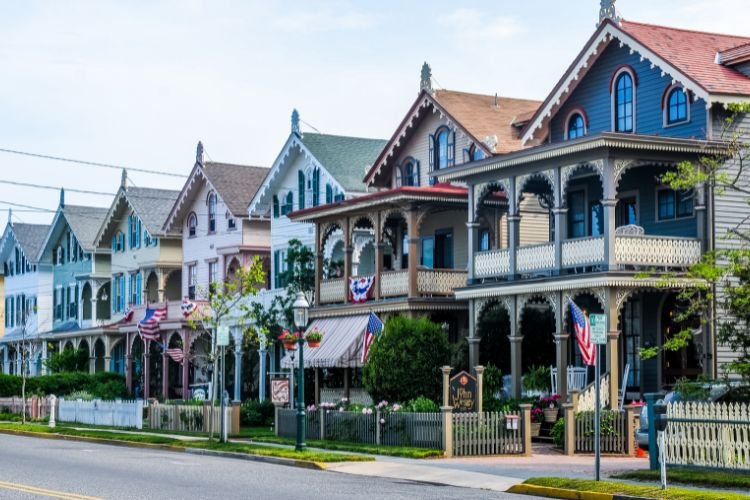
Reconstruction began quickly. The prevailing architecture was not chosen by later preservationists. It was the contemporary language of builders working after the fire. Porches, brackets, towers, patterned shingles, and elaborate trim belonged to the period’s tastes and technologies.
Speed did not mean sameness. Owners varied scale and ornament according to means and ambition. Hotels needed rooms and public spaces. Cottages needed shade, ventilation, and a face turned toward the street. The district grew as a practical resort and an architectural display.
04
What the fire did not create
It is too simple to say the fire “made” Victorian Cape May. Buildings from before 1878 survived, and later construction added other styles. Economic change, rail travel, competition from other resorts, and twentieth-century preservation all shaped what remains.
The fire is one hinge in a longer story. It concentrated rebuilding in a visible period, which helps explain the unusual coherence visitors feel. Yet that coherence includes survival, alteration, demolition, neglect, and rescue.
05
From unfashionable to irreplaceable
Cape May did not remain America’s newest resort. Larger hotels and different entertainments drew travelers elsewhere. The relative lack of relentless redevelopment helped older buildings survive, though survival was never assured.
By the twentieth century, residents and preservationists began to argue that the old architecture was not an obstacle to progress but a civic asset. The Historic District’s national recognition in the 1970s gave that argument institutional force.
06
Walking the evidence
Stand on a residential block and look at rooflines, porches, and narrow lots. The fire itself is invisible, yet its aftermath appears in the density of late-nineteenth-century design. Then look for the buildings that do not fit a single date. They keep the story honest.
A town rebuilt after disaster is not a stage set. It is the work of laborers, owners, servants, craftspeople, officials, and families. The beauty deserves admiration. The history deserves the more difficult courtesy of attention.
A slower way to carry the story
Leave one hour unclaimed. Walk a route connected with the subject and notice changes in light, sound, material, and pace. Write one clear sentence about what is present. Description disciplines the eye because it resists the easy substitution of mood for fact.
Return to one location at a different hour. Morning and evening do not simply alter a photograph. They change who uses a street, which details become visible, and how the coast sounds. Compare expectation with observation. Let the difference remain in the notes.
When conversation arises naturally, ask a person who works in town one plain question. Listen without asking them to perform local knowledge. Courtesy is a better guide than curiosity without limits, especially in a community that receives visitors every day.
Read one primary source after the walk. Separate documented history, local legend, personal memory, and present-day operations. All can enrich a visit, but they should not be confused. Precision does not diminish wonder. It gives wonder a sound foundation.
End somewhere you can sit. Review the day without forcing it into a verdict. A place becomes richer when it resists summary. The goal is not to master Cape May in an afternoon. It is to leave with a better question than the one you brought.
A reader’s field exercise
Carry four questions into the streets
Before the fire
Find one visible detail connected with this idea. Describe it before photographing it. Ask what the place reveals and what the first glance leaves unexplained. Then locate the primary source that can test your first impression. Record its date, name the institution responsible for it, and notice where documented fact ends. A careful visitor can enjoy atmosphere without asking atmosphere to serve as proof.
The November blaze
Find one visible detail connected with this idea. Describe it before photographing it. Ask what the place reveals and what the first glance leaves unexplained. Then locate the primary source that can test your first impression. Record its date, name the institution responsible for it, and notice where documented fact ends. A careful visitor can enjoy atmosphere without asking atmosphere to serve as proof.
Rebuilding at Victorian speed
Find one visible detail connected with this idea. Describe it before photographing it. Ask what the place reveals and what the first glance leaves unexplained. Then locate the primary source that can test your first impression. Record its date, name the institution responsible for it, and notice where documented fact ends. A careful visitor can enjoy atmosphere without asking atmosphere to serve as proof.
What the fire did not create
Find one visible detail connected with this idea. Describe it before photographing it. Ask what the place reveals and what the first glance leaves unexplained. Then locate the primary source that can test your first impression. Record its date, name the institution responsible for it, and notice where documented fact ends. A careful visitor can enjoy atmosphere without asking atmosphere to serve as proof.
Stay on public routes. Respect homes, wildlife, posted closures, and the work of local businesses. A more attentive visitor usually becomes a lighter presence.
Plan with confidence
Current information outranks an old list
Hours, prices, menus, transportation, and access can change. Use this story to understand the choice. Use the official source to confirm the final detail for your date.
Reader questions
Cape May fire of 1878 FAQs
Direct answers with links to the institutions that hold the current record.
When was the Great Cape May fire?
The major fire discussed here began on November 9, 1878.
Where did it start?
Historical accounts identify the Ocean House hotel as the starting point.
Did the fire create all of Cape May’s Victorian buildings?
No. Some buildings predate it and others came later, but the rebuilding concentrated late-Victorian construction.
Was Cape May rebuilt immediately?
Reconstruction moved rapidly as owners prepared for future resort seasons.
How can visitors learn more?
Use the City historic-preservation materials, Cape May MAC interpretation, and the Historic District itself.
The journal continues
Read Cape May with a slower eye
Explore original stories and practical guides to the architecture, coast, food, wildlife, and people that give the town its character.
Pingback: The Lost Grand Hotels of Cape May: A Seaside History