
Where dangerous water called forth public courage
Cape May Shipwrecks and the Coast’s Lifesaving Legacy
The waters around Cape May are beautiful because they are powerful. The Atlantic meets Delaware Bay near shifting shoals, heavy weather, and one of the nation’s great shipping approaches. Wrecks made the coast a place of grief, salvage, warning, and rescue. The lifesaving institutions that followed became part of the ancestry of the modern Coast Guard.
The waters around Cape May are beautiful because they are powerful. The Atlantic meets Delaware Bay near shifting shoals, heavy weather, and one of the nation’s great shipping approaches. Wrecks made the coast a place of grief, salvage, warning, and rescue. The lifesaving institutions that followed became part of the ancestry of the modern Coast Guard.
01
A difficult meeting of waters
Vessels approaching Delaware Bay have long navigated currents, shoals, fog, storms, and a low coastline that could be difficult to read. Sailing ships had limited ability to recover once wind and sea drove them toward shore.
A wreck was not only a maritime event. It reached coastal households, merchants, pilots, salvors, and burial grounds. News traveled through the community before formal rescue systems could arrive.
02
From local rescue to public service
Coastal people attempted rescues with the boats and knowledge available to them. During the nineteenth century, the federal government gradually built a more systematic network of lifesaving stations, equipment, drills, patrols, and trained crews.
The Coast Guard historian records a lifesaving station at Cape May Point beginning in 1849. Its location moved as the sea changed the land. That detail captures the coast’s central difficulty: the rescue station itself had to negotiate an unstable shore.
03
The surfmen’s work
Surfmen kept watch, patrolled beaches, maintained boats and beach apparatus, and trained for moments when launching into surf could endanger the rescuers as much as the wrecked crew. Discipline made courage repeatable.
The Monomoy surfboat and other craft were designed for rowing through broken water. Equipment mattered, but local judgment remained decisive. Crews had to read wind, current, darkness, and the condition of people already exhausted.
04
Toward the Coast Guard
In 1915, the United States Life-Saving Service and Revenue Cutter Service combined to form the Coast Guard. Cape May’s role continued through maritime patrol, aviation, war, rescue, and eventually recruit training.
The current training center stands within a longer military and maritime history at Sewell Point. Its mission is modern, yet the local association between Cape May and lifesaving reaches back well before the twentieth century.
05
How to encounter the history
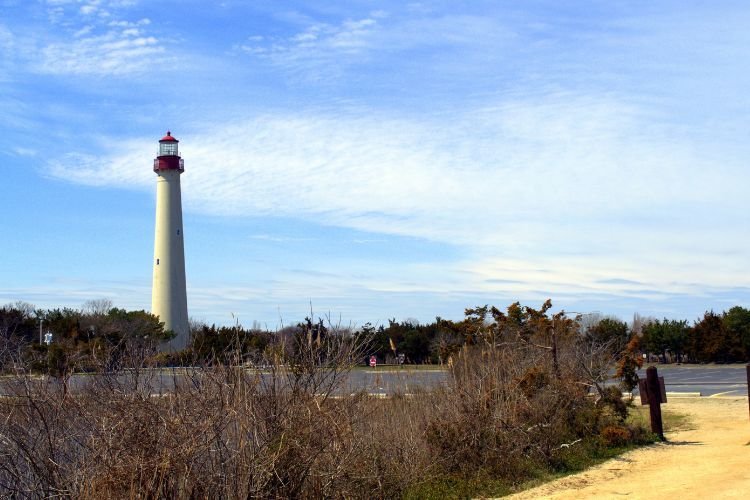
The Cape May Lighthouse provides a natural place to consider navigation and warning. The World War II Lookout Tower introduces a later era of coastal defense. Maritime museums and Coast Guard history pages preserve vessels, photographs, and technical knowledge.
Do not approach a wreck story only as adventure. Many ended in death, displacement, and long uncertainty for families. Responsible interpretation gives the people aboard their full humanity.
06
The living edge
Modern navigation and rescue technology have transformed maritime safety, not abolished risk. Rip currents, storms, cold water, and vessel emergencies still demand respect for official warnings and trained responders.
The lifesaving legacy is therefore not merely picturesque. It is a civic idea: preparation carried out in ordinary hours so that skill exists when the sea turns dangerous.
A slower way to carry the story
Leave one hour unclaimed. Walk a route connected with the subject and notice changes in light, sound, material, and pace. Write one clear sentence about what is present. Description disciplines the eye because it resists the easy substitution of mood for fact.
Return to one location at a different hour. Morning and evening do not simply alter a photograph. They change who uses a street, which details become visible, and how the coast sounds. Compare expectation with observation. Let the difference remain in the notes.
When conversation arises naturally, ask a person who works in town one plain question. Listen without asking them to perform local knowledge. Courtesy is a better guide than curiosity without limits, especially in a community that receives visitors every day.
Read one primary source after the walk. Separate documented history, local legend, personal memory, and present-day operations. All can enrich a visit, but they should not be confused. Precision does not diminish wonder. It gives wonder a sound foundation.
End somewhere you can sit. Review the day without forcing it into a verdict. A place becomes richer when it resists summary. The goal is not to master Cape May in an afternoon. It is to leave with a better question than the one you brought.
A reader’s field exercise
Carry four questions into the streets
A difficult meeting of waters
Find one visible detail connected with this idea. Describe it before photographing it. Ask what the place reveals and what the first glance leaves unexplained. Then locate the primary source that can test your first impression. Record its date, name the institution responsible for it, and notice where documented fact ends. A careful visitor can enjoy atmosphere without asking atmosphere to serve as proof.
From local rescue to public service
Find one visible detail connected with this idea. Describe it before photographing it. Ask what the place reveals and what the first glance leaves unexplained. Then locate the primary source that can test your first impression. Record its date, name the institution responsible for it, and notice where documented fact ends. A careful visitor can enjoy atmosphere without asking atmosphere to serve as proof.
The surfmen’s work
Find one visible detail connected with this idea. Describe it before photographing it. Ask what the place reveals and what the first glance leaves unexplained. Then locate the primary source that can test your first impression. Record its date, name the institution responsible for it, and notice where documented fact ends. A careful visitor can enjoy atmosphere without asking atmosphere to serve as proof.
Toward the Coast Guard
Find one visible detail connected with this idea. Describe it before photographing it. Ask what the place reveals and what the first glance leaves unexplained. Then locate the primary source that can test your first impression. Record its date, name the institution responsible for it, and notice where documented fact ends. A careful visitor can enjoy atmosphere without asking atmosphere to serve as proof.
Stay on public routes. Respect homes, wildlife, posted closures, and the work of local businesses. A more attentive visitor usually becomes a lighter presence.
Plan with confidence
Current information outranks an old list
Hours, prices, menus, transportation, and access can change. Use this story to understand the choice. Use the official source to confirm the final detail for your date.
Reader questions
Cape May shipwreck history FAQs
Direct answers with links to the institutions that hold the current record.
Why were shipwrecks common near Cape May?
Shoals, storms, currents, fog, and traffic approaching Delaware Bay all contributed to risk.
When did Cape May have a lifesaving station?
The Coast Guard historian records a Cape May Point station beginning in 1849.
What was the United States Life-Saving Service?
It was a federal rescue organization that became part of the Coast Guard in 1915.
Can visitors see lifesaving artifacts?
Regional maritime museums preserve boats, displays, photographs, and related history.
Is the Coast Guard still important in Cape May?
Yes. Training Center Cape May is the Coast Guard’s enlisted recruit training center.
The journal continues
Read Cape May with a slower eye
Explore original stories and practical guides to the architecture, coast, food, wildlife, and people that give the town its character.